
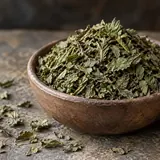
Dried mint is deeper, rounder and less sharply cooling than fresh. Turkish, Persian, Levantine and Greek cooks reach for it on purpose, for soups, yoghurt, meatballs and sizzling mint oil.
Dried or fresh?
Drying takes away mint's bright, grassy, sharply cooling top notes and leaves a deeper, warmer, slightly hay-like flavour that stands up to heat. That is why it is not simply a substitute. In much of the eastern Mediterranean and western Asia, recipes specify dried mint on purpose, and fresh mint would taste wrong.
Use dried mint where the herb is cooked, fried in fat, or mixed into something rich. Use fresh where it is eaten raw and should taste green: salads, tabbouleh, mint sauce, drinks, and anything scattered on at the end. See mint for the fresh herb.
In the kitchen
- Sizzling mint oil. Warm butter or oil, add a teaspoon or two of dried mint off the heat and let it foam for a few seconds, then pour it over lentil soup, ezogelin, yoghurt or Persian kashk-e bademjan. It burns in moments, so take the pan off the heat first. See persian-cuisine and turkish-cuisine.
- Yoghurt. Stir into cacık and other garlicky yoghurt dips with a little olive oil.
- Meat. Knead into köfte, Greek keftedes and lamb meatballs, and into the rice filling for vine leaves and stuffed peppers.
- Salads and cheese. A pinch in fattoush dressing; Cypriot halloumi is traditionally packed with dried mint.
- Tea. Dried mint makes a good tisane on its own or with black tea.
Rub it between your palms as you add it to wake up the aroma.
How much to use
About 1 teaspoon of dried mint for 1 tablespoon of chopped fresh, the usual three-to-one rule (see fresh-vs-dried-herbs). For a pot of lentil soup serving four, 1–2 teaspoons is plenty, and about the same fried in butter for a finishing drizzle. Too much tastes dusty and medicinal.
Buying and storing
Good dried mint is green, not grey or brown, and smells strongly when rubbed. Turkish and Middle Eastern grocers sell it in large bags cheaply and it turns over quickly, so it is often fresher than a supermarket jar. Keep it airtight, away from light and heat, and replace it after about a year.
Mint is one of the easiest herbs to dry at home: hang small bunches somewhere warm and airy until crisp, then strip the leaves into a jar. See drying-herbs.